Monday, August 29, 2016

Bringing All Things to Light

As we quickly approach another presidential election, the disapproval and criticism surrounding both of our nation’s leading candidates is at the forefront of every media outlet. There are reports that Donald Trump is angry, erratic, unfair in business dealings, greedy, a loose cannon, and an adulterer.  Hillary Clinton, on the other hand, is broadcast as a liar, a crook, inauthentic, extremely careless, and a self-serving individual who thinks she is above the law. 

Name-calling and accusations such as these are commonplace during presidential elections.  The candidates’ lives are placed under a microscope, as they should be, and all their dirty laundry is aired for the world to see.  As their lives are examined, the good, the bad, and the ugly come to the surface.  All their faults and failures are exposed.  Every one of their sins comes to light, which leads me to wonder how I would fair if my life came under the same scrutiny as that of a presidential candidate. 

It’s easy for me to cast stones at Donald Trump or Hillary Clinton, but what if someone were to take a peek into my life?  Or into your life?

While we might not ever run for public office, there will come a day when even the things we have done in secret will be made public.  When Jesus Christ returns to earth, as He has said He will, “He will bring every deed into judgment, with every secret thing, whether good or evil” (Ecclesiastes 12:14).  On that Final Day of Judgment, He will disclose every sin, including the purposes and intentions of our heart (1 Corinthians 4:5). 

When Christ finally does appear, how will you measure up?  When He returns to repay each person according to what they’ve done (Matthew 16:27), what will be said of you?  If you’re anything like me, your sins are much worse than those of our current presidential candidates.  If you’re like me, you’d cringe at the idea of having your skeletons revealed to the masses, much less having the secret thoughts and intentions of your heart exposed before the Almighty God Himself.  Therefore, if you truly are a sinner like me, the only hope you have is to cling to Jesus and to His righteousness.  He lived a sinless life, and He gave Himself for wicked sinners such as you and me.  So I implore you to trust in His works and not in your own.  For there will come a day when your heart and soul will be unmasked, and this unveiling will far outweigh any exposure our presidential candidates have ever known.  On that day you’ll have no way of covering up your scandals.  There’ll be no place to run and hide.  You won’t be able to lie your way out of condemnation, for God has all the facts.  He sees and knows all, even the true intentions of your heart.

If this disturbs you or if you have questions, please feel free to contact me, or better yet, contact a pastor at a local church near you.  Here are a couple links you can use to find a good church in your area: 

Founders-Friendly Churches

9Marks Church Search


~Corey

Monday, August 22, 2016

Prone to Wander

I don't know about you, but many times I come to a sudden realization that distractions have completely overtaken me. Diversions tend to creep in unnoticed when I least expect them, and before I even recognize what's hit me, I'm spiritually parched and in need of refreshment - refreshment that can only be found by spending time in God's Word and in prayer. Over the years I've noticed that my spiritual life suffers most when I allow my circumstances to pull my attention away from God. There's no one to blame for this but myself. Just the other day my cheerleaders and I were discussing how a runner will naturally slow down if he takes his eyes off the finish line and begins looking at the other runners around him. The same is true in a believer's spiritual walk: If we take our eyes off Christ and start focusing upon the circumstances that encircle us, we'll undoubtedly start to slow down and veer off course. 

Often the things that lead me astray are good things in and of themselves, but too many times I allow those things to reign over my thoughts and my actions. Circumstances consume me and step in to vie for my attention, attempting to draw my focus off of the very One my heart needs most. My walk with the Lord is filled with hills and valleys. Thankfully, the trend line seems to be going upward as God molds me into the image of Christ. But it is a very slow growth, and sometimes seems stagnant. God's unending patience toward my wretched heart is overwhelming at times and, in response, I can only repent of my wanderings, focus my attention back upon Christ, and run the race set before me, knowing that God is the Author and Finisher of my faith.


O to grace how great a debtor daily I'm constrained to be!
Let thy goodness like a fetter, bind my wandering heart to thee
Prone to wander Lord I feel it, prone to leave the God I love
Here's my heart, O take and seal it, seal it for thy courts above.
(Robert Robinson)

Love,
Kristen

Monday, August 8, 2016

Pom Poms, Hair Bows, & Finding Our Identity in Christ

Not long ago, I took on the role of coaching a junior high cheer squad at a private Christian school in our town. Several years back I taught second grade at the same school, and now I'm coaching a few of my former students. It's so neat to see how those sweet little girls I taught years ago have blossomed into precious young women! It is a great privilege and a tremendous responsibility to be able to teach and mentor these young ladies. I've told them several times that, while I want them to be good "cheerers," it's more important to me that they be good "leaders." We've talked about what it means to be a leader among their peers: welcoming new students who come to the school, making sure everyone feels included, helping teachers, and serving others, even when it's not convenient or popular. I giggled as they asked me if I'd make them run sprints if they messed up a cheer or couldn't stick a particular stunt (that's cheer terminology for dropping the girl they're holding in the air). I explained to them that learning cheerleading skills is definitely an important part of being a cheerleader, but that being good at cheerleading isn't our top priority or our number one goal. To me, a lousy cheer routine doesn't begin to compare with a lousy attitude. I've told these girls already, and will continue to remind them, that they weren't selected to be part of the cheer team based solely upon their cheerleading abilities. Their character is what counts! But we can't stop there. 

You see, having good character from a worldly perspective certainly matters in this life, but it makes no difference in eternity. A person can seek to be well-mannered, kind, and hard-working, but if they don't know Christ, they have nothing. King Solomon paints a clear picture of this truth in the book of Ecclesiastes. He was a very rich and wise king who tested himself with all sorts of worldly endeavors and delights - hard-work, wise-living, and self-indulgence, to name a few -  but he found all these pursuits to be empty; like chasing after the wind. Phillip Holmes, a writer for Desiring God, said, "The problem is our hearts are black holes of discontentment, devouring relationships and possessions, all while screaming, 'I need more.' We're always eating, but famished. Always drinking, but never satisfied."  If the girls learn nothing else this year, I pray that the amazing truth of our ultimate satisfaction being found in Jesus Christ alone will cause their hearts to swell with adoration for Him.

When I first took this job, I began brainstorming ways I could share Christ's glorious gospel with these girls and could strive to show them the beautiful truths found in His Word. I thought about the sins teens struggle with most today. Undoubtedly, at the top of my list is the propensity for all females to compare ourselves with others, and the tendency we have to worry so much about pleasing and impressing people. While these have always been struggles for teenage girls, and women too, it seems to be so much worse now, as we all interact through social media, aiming to post the perfect photo and trying to give the impression that we live an ideal, pain-free life. These thoughts reminded me that all of us, no matter our age or gender, have one thing in common: We all need Christ! It's only once we have been saved by His marvelous grace and have been covered by His precious blood that we are truly free from our struggles. Only then can we seek to live holy lives and aim to please - not people - but Christ alone, trusting in His grace to carry us through when we fail. In that moment, as I pondered these ideas, I was reminded that as believers, our identity is found in Christ alone, and I decided that that would be our spiritual theme for the year: Finding Our Identity in Christ. For it is only when we identify ourselves wholly and completely in Christ that we will find satisfaction and fulfillment unlike anything we've ever known. Just as I told the girls in one of our devotionals: Yes, I am a wife, mother, daughter, sister, and cheer coach. But I can't take any of those identities with me when I die. They will be useless when I stand before God Almighty. The only identity that will matter in that glorious moment is that I am a child of God and that my identity is found in Christ alone. 


Love,
Kristen


Tuesday, August 2, 2016

Religious Liberty for All: A Christian Perspective

Let’s start with an obvious question: What exactly is religious liberty? Well, religious liberty grants Americans the freedom to worship as we please, and gives us the right to peaceably assemble as a religious group without interference from the government. It also grants us the right to speak freely about our religion and to persuade and proselytize others.

The First Amendment to the United States Bill of Rights, which was passed by Congress in September 1789 and ratified in December 1791, states that “Congress shall make no law respecting an establishment of religion, or prohibiting the free exercise thereof; or abridging the freedom of speech, or of the press, or the right of the people peaceably to assemble, and to petition the Government for a redress of grievances.”  

The Bill of Rights was ratified less than a decade after the American Revolution ended. The thirteen American colonies rejected and overthrew British rule, and thus adopted a governing document known as the Constitution of the United States of America. In the Constitution we find the Bill of Rights, written in order to ensure protection of individual liberties and to list specific prohibitions on governmental power.

Influenced by Thomas Jefferson, James Madison penned this first amendment to prohibit a national church. Great Britain’s national church, The Church of England, denied religious liberty at the time; therefore, the founders of the United States passed an amendment that prohibited the establishment of a national church. In addition to this, the first amendment also guarantees individuals the right to worship, freedom of speech, the freedom of the press, the right to peaceably assemble, and the right to make complaint/seek the assistance of the government without fear of punishment. While much could be said about the first amendment, I want to focus on religious liberty.

Russell Moore, the president of the Ethics & Religious Liberty Commission, points out that religious freedom does not mean freedom from being mocked or ridiculed. Nor does it mean freedom from being offended, but it does give us freedom to worship as we choose.

Is this always a good thing? Should Christians defend religious freedom for others with whom we disagree? Should we defend the rights of Muslims to freely worship, even though they deny Jesus as being equal to God? Should believers fight for the rights of Atheists to gather and speak freely when they deny the very existence of our Creator? Should Christians defend the rights of Satanists to worship as they choose, knowing that they bow down to the adversary of our Sovereign King?

I realize that these can be difficult questions to answer, particularly if we believe that these groups are fighting against us and stand in direct opposition to our faith. It would seem as if we are advocating blasphemy against the Holy God. Well, here is some food for thought:

Jesus preached in the Sermon on the Mount, “So whatever you wish that others would do to you, do also to them, for this is the Law and the Prophets” (Matthew 7:12). In this text we see Jesus call us to treat others in the same way that we want to be treated. Now, I realize this is an extremely difficult command, especially when the other person does not always treat you well in return.  But if you’ll notice, in Matthew 7, Jesus doesn’t add any conditions. He doesn’t say, “Do unto them as you want them to do to you, as long as they treat you how you want to be treated.” Essentially He is saying, “Do unto them as you would have them to do unto you, regardless of what they do unto you.” If someone treats you with disrespect, Jesus calls you to treat that person with respect anyways.

So, one might ask, “How does this apply to religious liberty for all?” Well, let’s look at it this way: If I desire religious freedom for myself then I should desire religious freedom for others as well, even those with whom I strongly disagree. How could we possibly expect religious freedom for ourselves and, in turn, deny the same freedom to others? Russell Moore, in his book Onward, uses Muslims as an example as he paints a clear picture of this idea for us. He writes, “Christians should fight for the liberty of Muslims to be Muslims, to worship in Mosques, and to freely seek to persuade others that the Koran is the true revelation of God.” He says these things, not because he affirms Islamic claims, but because he affirms the power of God. You see, like Moore, I believe in advocating and defending the rights of any religious group to freely worship, to freely proselytize, and to peaceably gather, but I am by no means affirming their doctrines. I am simply confident in Christ’s Gospel and am persuaded that His truth will prevail. After all, the Gospel is the power of God for salvation to all who believe (Romans 1:16).

The Christian faith does not depend upon law and governmental force in order to advance the kingdom of God.  Suppressing other religious groups is not God’s means for advancing His kingdom. He doesn’t need other religions to be suppressed in order for His truth to shine brightly. It is the Gospel of our Lord Jesus Christ alone that advances the kingdom throughout pagan lands. In Onward, Moore points out, “A religion that needs state power to enforce obedience to its beliefs is a religion that has lost confidence in the power of its Deity.”

Therefore, we have to ask ourselves: Are we living out of fear?  Have we lost confidence in the power of God? Are we scared of diversity and disagreement? Do we think that the Gospel is unable to withstand other religions?

If we are united with Christ, we have a promise that God has not given us a spirit of fear, but one of power and love and self-control (2 Timothy 1:7). Christians need not fear other religious groups or other ideas, even if those ideas lead to violence. Jesus told His disciples in Matthew 10:28, “Do not fear those who kill the body but cannot kill the soul. Rather fear Him who can destroy both soul and body in hell.”

Rather than retreat, we should rejoice in times such as these. Isn’t it wonderful that while Matthew 28:19 calls us to go make disciples of all the nations, we are currently watching as all the nations come to us? Yes, there are tensions, and yes, there are potential dangers, but we should praise God as we see Him plopping the nations right into our laps, here in the United States.

One reason for this mass flood of people into our country is Amendment One to the Bill of Rights. It is the freedom of worship and freedom of speech that lead many to this nation. You see, individuals don’t typically flee to countries like the Islamic Republic of Iran for religious freedom, which is why 98% of the population is Muslim, but many freedom-seekers do come to the United States.

My call for the Christian is to stop living in fear and to see the amazing opportunity that is right before our eyes, as God brings the mission field to us. I live in the outskirts of Houston, Texas, which is actually becoming one of the most ethnically diverse cities in the world. Last time I checked, there are somewhere between 350 to 400 different ethnic groups in the Houston area. As we observe this incredible influx of people, we have to remember that Muslims are not our enemies, Hindus are not our opponents, Buddhists are not our competitors, Atheists are not our adversaries, and Satanic groups are not our nemeses. We are all created in the image of God; therefore, let us talk with our Muslim neighbor, let us befriend our Hindu co-worker, and let us share the Gospel with our Atheistic family member. Jesus is the only hope for any of us!

And as for the Christian, let us thank God for religious liberty, and let us defend the rights of others to worship as they choose, not because we affirm their convictions, but because we believe the Gospel of our Lord and Savior Jesus Christ is the power of God for salvation to all who believe.

Friday, July 22, 2016

Are You One of the Good Guys?


In the past year Americans have seemingly gone to war with one another, as we’ve experienced great disunity between those who claim to side with Black Lives, with Blue Lives, or with All Lives. Unfortunately, extreme hostility has emerged before our eyes as people are killed on every side of the issue. Not only that, but terrorist strikes come one after another, all over the world.  As we look around, we don’t have to look far to realize that this world is filled with all sorts of evil. Have you ever wondered how we got this way?  Have you wondered just what kind of world we’re living in?  In my last blog post I addressed the issue of God in relation to human suffering and evil, but this time I’ll address our relationship to the wickedness and evil we see around us every day. 

How on earth could anyone commit the evils we’ve observed lately as we watch the evening news?  How could someone take an axe and attack people on a train in Germany?  How could anyone deliberately drive a truck into a crowd with the intent to slaughter other humans?  And, hitting more closely to home, how could anyone deliberately shoot the very people who are protecting protestors?  How is it that a person could want to kill someone due to the color of his or her skin or the occupation they’ve chosen?  Surely the problem lies with “those people,” and not with us.  There’s no way that you or I are capable of committing these heinous acts of violence, right? Right?! Could it be possible that it’s not “us” versus “them”?  Instead, maybe we are them, and they are us.  It would be nice to think that I’m one of the good guys, but how do I really know I’m one of the good guys?  How can I really know that, even in the darkest days of my life, I’d be incapable of doing these evil and wicked acts myself?

Historically, the Christian church has believed in the doctrine of original sin.  Simply, this doctrine teaches that when the very first humans fell into sin, the entire human race was affected.  David, in Psalm 51:5, wrote, “Behold, I was brought forth in iniquity, and in sin did my mother conceive me.”  David was acknowledging the fallen human condition that he inherited when he was conceived, and the church has historically embraced this doctrine.

However, during the Enlightenment, modern thinkers began to oppose the traditional, Christian view of mankind as being inherently sinful, and instead began to view mankind as being inherently good.  While this doctrine played out in various ways for different Enlightenment thinkers, their ideas have nonetheless carried on and are of great influence upon our thinking today.  We see it clearly in our culture’s focus upon self-esteem, which I will define as the love of self and self-worth.  This self-esteem ideology concentrates on the building up of oneself and on seeing one’s inherent worth and value.

But here lies the tension: What if humans truly are inherently evil? Or what if we are, at the very least, not good?  How then will building up the self benefit a person?  What if each of us is capable of committing all the heinous and atrocious acts that we are currently seeing in the news?  What if it is only by God’s grace that we are restrained from acting upon what is truly in our wicked hearts? 

So my question for you is this:  Are we inherently good, or is this just how we want to view ourselves?  After all, if we’re fallen creatures (Genesis 3), our perception of ourselves will be radically different from reality.  How can we trust our own evaluation of ourselves? We can’t. Therefore, we look to the Bible, which is reliable and trustworthy.  Our inclinations and feelings are subjective, but God’s Holy Word provides us with objective truth; truth that is absolute whether we agree with it or not. It’s in the Bible that we learn about the radical corruption of mankind, also known as total depravity. 

God’s Word teaches us that no one is righteous, no one does good, and that all have sinned and have fallen short of God’s glory (Romans 3:10-18; 23).  The Bible also declares that every intention of the thoughts of man’s heart is only evil continually (Genesis 6:5; 8:21), that the heart of man is deceitful above all things, and that the human heart is desperately wicked (Jeremiah 17:9).   

Now, this doesn’t mean we will do all the evil we’re capable of doing.  Fortunately for us, God’s common grace restrains many people from acting upon the true inclinations of the heart.  God has placed the government, the church, our families, and other institutions into our lives to teach us and to prevent us from acting upon the true nature of our will.  However, just because we don’t carry out all the evil acts of which we are capable, that doesn’t necessarily make us good.    

As descendants of Adam we are all born in him, which means that we are all born with a sin nature.  Clearly stated, every one of us is born as an unrighteous, self-serving human being.  As R.C. Sproul puts it, “We are not sinners because we sin.  We sin because we are sinners.”    

This is why we see all sorts of evil atrocities around us, and if not for the grace of God, every one of us would commit the same heinous acts, if not worse.  We are all sinners by nature; therefore, we all have a serious problem.  The problem, however, is not that we are capable of executing all sorts of wicked, malicious evils; the problem is that each one of us is at enmity with God.  Every single one of us is rebelling against the Holy God.  Every single one of us loves our own self more than we love the Creator who made us for Himself.  The first chapter of the book of Romans teaches us that while God created us, we fail to honor Him as God.  He created us and gives us all things, but we fail to give Him thanks.  And while He has given us His truth, we suppress that truth.  We act like the truth isn’t there.  We run away from the truth of God and exchange that truth for lies; lies such as the inherent goodness of humanity.  We think that we know ourselves best and that we know what is best for ourselves.  Each of us wants to be reigning on our own throne.  Each of us desires to be the master and ruler of our own little world – If you have children, you don’t have to look far to observe this truth. 

Thus, since we are sinners who stand in opposition to the Holy and Just God, we are in terrible trouble.  We are at His mercy, and His perfect holiness demands justice.   

Fortunately for us, His justice has been satisfied in Jesus Christ, who went to the cross, who suffered and died, and who experienced the full wrath of God against sinners.  And now, Jesus invites us all to come to Him, to take refuge in Him, and to inherit His righteousness. He inherited our sin, not our sin nature.  He took our sin to the cross and paid the ultimate price.  In our place condemned He stood, and He gave His life on behalf of sinners like you and me.   

Therefore, the solution to all the trouble around us is not to think more highly of ourselves, but to look to Jesus Christ, our Savior.  What this world needs is not more self-help or greater self-worth.  This world needs a Savior!  And thankfully, God tells us that if we confess with our mouth that Jesus is Lord and believe in our hearts that God raised Him from the dead we will be saved (Romans 10:9-13).


~Corey


Friday, July 15, 2016

The More I Grow, the Less I Know: I am a Worrier

I have a confession to make: I am a worrier. I've heard it said before that worry is one of those "respectable sins." You know, sins like adultery or murder are seen as heinous, while other sins, such as gluttony or worry, tend to be overlooked or are viewed as the not-so-bad brand of sin. We often justify ourselves because we're only human, after all. We'll say something like, "That's just my personality," or "That's just how God made me," instead of taking responsibility and calling it what it is - SIN. Ouch.

One of the elder's wives at my church is currently leading a four-week self-examination study during our Wednesday night gathering. She has been emphasizing the need for undeniable, honest, and authentic change in our lives. The more I know God and the more I learn of His character, the more it should spur me on to change. True change. Change that causes me to think and live differently. We can say all day long that we trust in God's sovereignty or that we know He has a good plan for His children, but if we don't live like we believe it, what's the point? As far back as I can remember people have presented similar ideas, using catchy statements such as, "You can talk the talk, but can you walk the walk?" But in all the times I've heard this truth, it has never affected me quite like it did in that moment during our Wednesday night study. God used her words to impact me in a fresh, new way, as if I were hearing this idea for the very first time (Isn't it awesome how God does that?). I want to not only believe that God's plan for me is good, but I want to wholly live it out in every respect; I want my life to reflect the attributes of God that I know to be true from His Word, no matter what circumstances I may face. 

A friend and I were recently discussing how we tend to worry and complain, even though we see God's goodness and love in so many aspects of our lives. "We're just like Israel, aren't we?" I asked her. So many times I have wondered how the Israelites could so quickly forget what God did for them (See all of Genesis and Exodus, plus much more!), and here I am doing the same thing. God is faithful! God is loving! God is merciful! I've seen evidences of His goodness over and over again in my life, but I continue to worry about the future and to question His goodness. Will I ever learn? Will I ever get to the point where I can honestly say that I am completely content in His plan for my life and that I don't feel the need to be in control? When will the things I know to be true about God impact me to the point of a permanent change when it comes to worrying (and many other areas of my life, for that matter)? Boy, am I grateful for His kindness and patience towards me!

The more God grows me up in His Word, the more clearly I see my depraved state before Him. Even my best intentions are marred by my sin. Does this make me wallow in sadness and self-pity? No way! It makes me all the more thankful for Jesus Christ! God's grace is sufficient, and I can trust that He is gripping me tightly and won't let me go - not because of my poor attempts at being a non-worrier, but because of Christ's atoning blood. I strive to live a holy life that is pleasing to God, but I know that I'll fail, and I'm thankful that He sees my sinful state and loves me anyways. I serve a great God - the more I know about Him, the greater He becomes to me and, in return, the lesser I become to myself. Praise God! 


Love,
Kristen

Wednesday, July 6, 2016

Where is God in our Pain and Suffering?

This past week, we saw another horrific act of terror as over 40 people were killed and more than 150 were injured in a bombing at an airport in Istanbul, Turkey. I don’t know if it’s the increased news coverage or if there truly has been an increase in the number of terrorist attacks, but these acts of terror appear to be happening more and more frequently. As these dreadful acts of terror take place, we can’t help but wonder why. Why in the world does so much evil exist? Where is God in the midst of all this pain and suffering? Why doesn’t He do something about it? Well, I don’t intend to answer this question fully, but I do intend to introduce how the Christian worldview sees God’s relationship to pain and suffering. 

First off, God is sovereign; there is nothing outside His control, including our pain and suffering. Jesus says in Matthew 10:29-30, “Are not two sparrows sold for a penny? And not one of them will fall to the ground apart from your Father. But even the hairs of your head are all numbered.” Jesus is teaching us that there is not even one bird that God does not sovereignly reign over – even their deaths are in His hands. The context of this passage is teaching us not to fear God but to trust in Him, for He reigns over the seemingly insignificant sparrows, and He even knows how many hairs on your head.  He doesn’t just know these things from observation; He knows because He is the Creator.

Second, God is good; He is perfect in every way. Psalm 25:8 reads, “Good and upright is the Lord; therefore he instructs sinners in the way,” and James 1:13 says, “Let no one say when he is tempted, ‘I am being tempted by God,’ for God cannot be tempted with evil, and he himself tempts no one.” We see here that God is sovereign and good, and not only that, but God also created a world that was very good (Genesis 1:31). It is God’s nature to create that which is good, because He is the very essence of goodness. 

Herein is where the problem lies from a humanly perspective. If God is good and sovereign, then why does anything exist that is not good? Why do bad things happen if God is powerful enough to stop them? These are very difficult questions, and we need not speculate here but instead should continue to look at what we know. What we know from God’s Word is that pain and suffering entered into the world as a result of man’s sin (Genesis 3:16-19). When Adam and Eve rebelled against God in the Garden, along came pain, suffering, and death.   

Therefore, while God is sovereign and good, pain and suffering are a result of man’s sin. No, I cannot tell you why man sinned in the first place – All I can tell you is what I know from God’s Word. Man was tempted and man sinned against the Holy God. Once sin entered the world, pain, suffering, and death came with it. While the Bible does not tell us why, it does teach us that God is not indifferent to our pain and suffering. In fact, God chose to become man and to suffer on this earth. That’s worth reading one more time: God chose to suffer. God who need not suffer, for He is lacking in nothing, chose to suffer. He became like us in flesh and blood, and then suffered the most heinous death on the cross. God suffered firsthand as we suffer (Hebrews 2:14-18; Hebrews 4:14-16).

In Mere Apologetics, Alister McGrath writes,

“In the incarnation, God the creator enters into this world of pain and suffering – not as a curious tourist, but as a committed Savior.  Christians thus recognize that God’s loving commitment to a suffering world was so great that God entered it personally – not sending some representative, but choosing to share in its pain and suffering.”

God the Son became flesh and lived among us and suffered alongside us. He is able to sympathize with us because He knows our suffering. In Revelation 2:9, Jesus says to the church in Smyrna, “I know your tribulation and your poverty and the slander of those who say that they are Jews and are not, but are a synagogue of Satan.” Jesus doesn’t just observe their pain and suffering from a heavenly view, He actually understands it; He knows it. In fact, the church at Smyrna shares in His suffering. Jesus Christ, who doesn’t just see our suffering, but who, in fact, knows it and has experienced it, now welcomes us to come to Him to take refuge in Him who has overcome this world. He tells us that in this world we will have tribulation, but to take heart because He has overcome the world. Not only this, He also invites us to Himself and says that in Him we will have peace. 

So whenever you hear people ask, “Why doesn’t God do something about the pain and suffering that we are experiencing?” You can answer, “He has.” He has done something! He has sent His Son to die in our place.  Romans 8:2 reads, “For the law of the Spirit of life has set you free in Christ Jesus from the law of sin and death. For God has done what the law, weakened by the flesh, could not do.”

And not only has He already done something, but one day He will do something else – He will completely free His people from pain and suffering.  We acknowledge that the world is not as it should be. We live in a fallen world, where we are surrounded by war, terror, injustice, and greed, but one day God will wipe it all away. There will come a day when God will make all things right; He will rid this world of pain and suffering; He will make all things new (Revelation 21:1-5). 

While I cannot answer specifically why we experience pain and suffering, I can point you to God Almighty who is sovereign over pain and suffering. He rules over it. He has done something about it, and He will do something about it – He will finish His work in the future. I am a finite creature, and therefore I don’t know why God does as He does. That is what makes Him God, and that is what makes me man. I cannot comprehend the mind of God, but I can point you to Him who is the answer in the midst of all our pain and suffering. 
Much more could be said, but here are my concluding thoughts on pain and suffering:

1)   When we view the problems of pain and suffering, we often do so from a humanly perspective. We think that we somehow deserve something better, that we have a right to be happy, prosperous, and comfortable. However, we forfeited that right the day we rebelled against the Holy God. But now He invites us to come to Him and escape this tragic reality of sin, suffering, and death.

2)   When we view the problems of pain and suffering we tend to forget the many blessings that God bestows upon us now. If you recall from Romans 1, one of the marks against fallen humanity is that we fail to give thanks to God. One reason man focuses upon the bad is because we don’t want to acknowledge God and the good things that He has given us. 

3)   Although people may claim otherwise, the problems of pain and suffering are not the main reasons most people reject God and lose their faith. The main reason is unbelief. This is why, when sharing the Gospel and defending our faith, it is so important to know who we are talking to and why they have raised the question about pain and suffering in the first place. Is it truly an intellectual stumbling block, or is it just a defense mechanism they use to justify themselves as they continue walking in unbelief? 

4)   The Christian worldview is the only worldview that can truly stand up to the problem of evil. And while we do not understand it fully, we can turn to God and trust in Him. If evil is outside of His control, then we are in a world of trouble. On the other hand, if evil exists and God does not, then we have no hope. It is comforting to know that since God is in control of our suffering, He is using it for good. Romans 8:28 says, “And we know that for those who love God all things work together for good, for those who are called according to his purpose.” Additionally, we can be sure that there is nothing, including evil, that can stop the purposes of God (Romans 8:31-38).

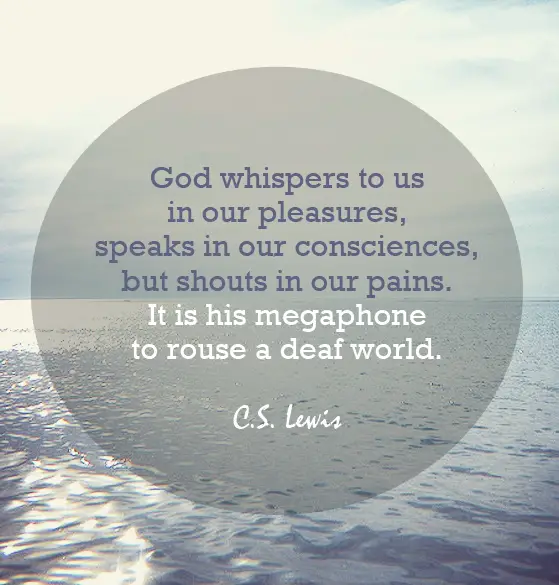
5)   The final and most important point is this: If pain and suffering did not exist, we would know nothing of the sweetness of the cross.  Pain and suffering point us to God and to His goodness. Many times we think too lightly of pain and suffering, as if these trials are a mistake, but if we truly believe God’s Word, then we know that God works all things for our good. He used His own pain and suffering on the cross to bring about our salvation, and He uses our pain and suffering to continually point us to Him. C.S. Lewis called pain God’s megaphone. He said, "Pain insists upon being attended to. God whispers to us in our pleasures, speaks in our consciences, but shouts in our pains. It is his megaphone to rouse a deaf world."

So, whenever we experience times of trouble and pain, let us look to God and thank Him for these times. God often uses the hard times, when we have nowhere else to turn, to reveal Himself to us and to cause us to fall on our knees and call upon His name.

Psalm 121
   I lift up my eyes to the hills.
From where does my help come?
   My help comes from the Lord,
who made heaven and earth.
   He will not let your foot be moved;
he who keeps you will not slumber.
   Behold, he who keeps Israel
will neither slumber nor sleep.
   The Lord is your keeper;
the Lord is your shade on your right hand.
   The sun shall not strike you by day,
nor the moon by night.
   The Lord will keep you from all evil;
he will keep your life.
   The Lord will keep
your going out and your coming in
from this time forth and forevermore.


~Corey